Research Digest
|
Psychology
Can AI Learn to Detect Sexism Through Human Perception
AI & Machine Learning
Psychology & Behavior
The Challenge of Detecting Sexism Online
Sexist and misogynistic content has been shown to reinforce discriminatory attitudes, marginalize women, and contribute to psychological harm. Worryingly, this material has become increasingly prevalent across social media platforms, with TikTok serving as a primary conduit. This harmful content is most frequently packaged and spread in the form of memes.
Automatically detecting sexist memes, however, remains notoriously difficult. Their meaning often emerges through the interaction of image, text, humor, irony, and cultural context. This ambiguity creates a form of “plausible deniability”, allowing creators to dismiss harmful content as “just a joke”.
As a result, even advanced AI systems struggle to reliably identify sexist content. Memes that appear harmless on the surface can still convey discriminatory meaning through subtle contextual cues.
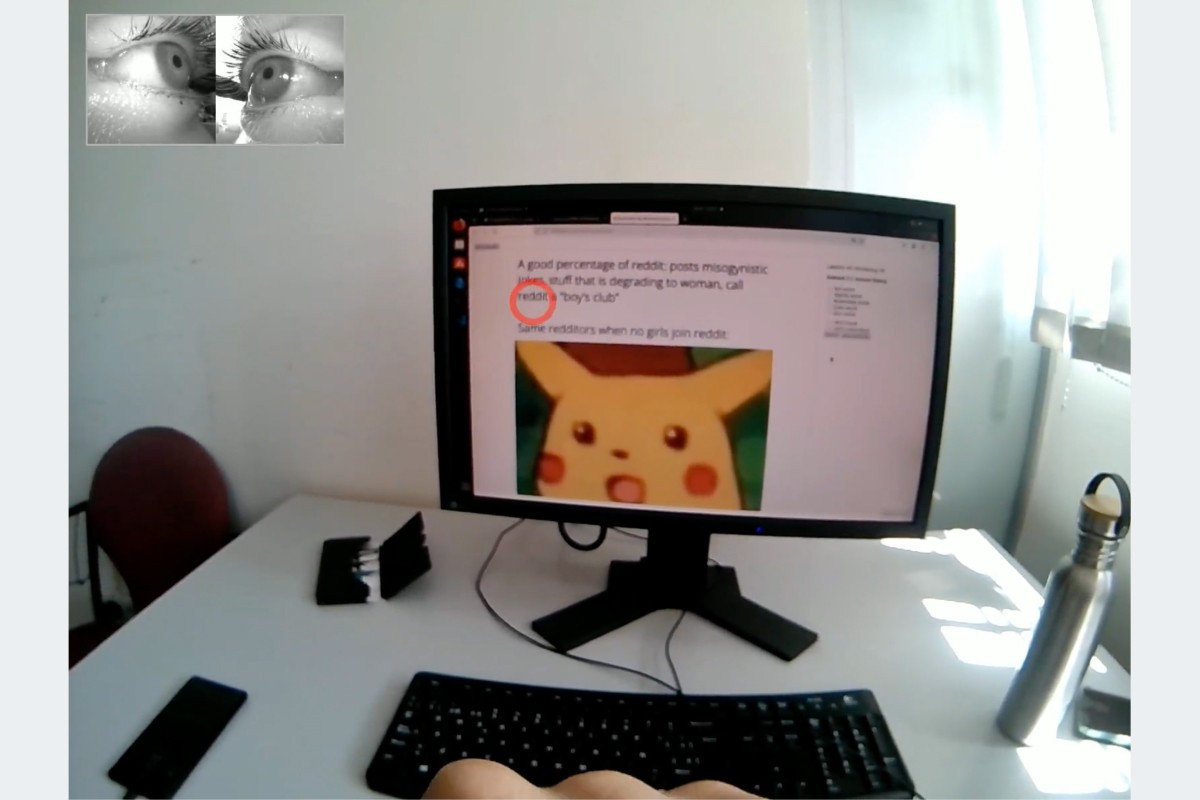
Video: A participant viewing sexist and non-sexist memes from the EXIST 2025 dataset while wearing Neon eye tracking glasses. Courtesy of Iván Arcos Gabaldón.
A Human-Centered Approach to AI
To address this problem, researchers Iván Arcos, Paolo Rosso, and Elena Gomis-Vicent from the Pattern Recognition and Human Language Technology Research Center (PRHLT) and the Valencian Graduate School and Research Network of Artificial Intelligence (ValgrAI) explored a different approach: instead of relying solely on human annotations, they investigated whether physiological responses could provide additional insight into how people process and interpret sexist content.
The research team recorded the physiological reactions of 16 subjects as they viewed nearly 4,000 memes from the EXIST 2025 dataset. To capture these multimodal signals in real time, they used Neon eye tracking glasses alongside continuous heart rate monitors and electroencephalography (EEG) headsets.
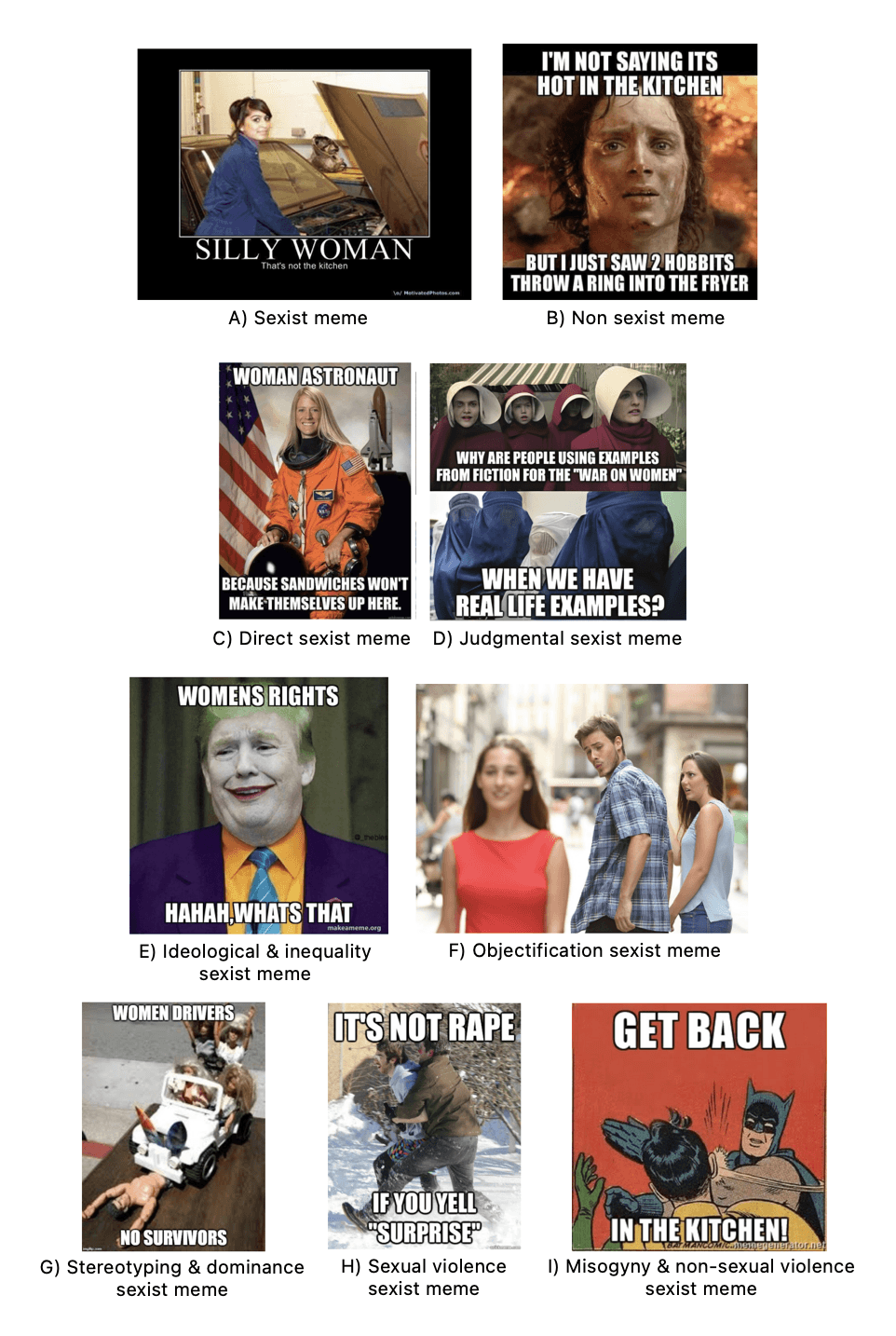
Figure 1: Examples of memes from different categories included in the EXIST 2025 dataset. Image adapted from Plaza, L., Carrillo-de-Albornoz, J., Arcos, I., Rosso, P., Spina, D., Amigó, E., Gonzalo, J., & Morante, R. (2025). Overview of EXIST 2025: Learning with Disagreement for Sexism Identification and Characterization in Tweets, Memes, and TikTok videos (Extended overview). In CLEF 2025 Working Notes. CEUR Workshop Proceedings.
What the Eyes Reveal About Sexism Perception
The recordings uncovered consistent physiological patterns linked to how participants processed sexist memes.
Sexist content required greater cognitive effort: Participants showed longer reaction times and more frequent fixations when viewing sexist content, especially in ambiguous or judgmental categories where interpretation was less straightforward.
Attention increased during direct sexist content: Blink durations became shorter when participants viewed directly sexist memes, a known indicator of sustained visual attention and increased cognitive workload.
Objectifying memes triggered aversive responses: Memes involving objectification produced measurable pupil constriction, a response commonly associated with unpleasant or emotionally negative stimuli.
EEG activity reflected higher evaluative processing: Brain activity patterns changed significantly during exposure to sexist content, particularly in regions associated with attention, evaluation, and conflict monitoring.
Together, these signals reveal aspects of perception that traditional image and text analysis often miss.
Teaching AI to Read Between the Lines
The researchers then integrated these physiological signals into a multimodal AI model designed to interpret memes through both content and human response.
By combining textual and visual meme representations with patterns of gaze behavior, blink activity, pupil response, and brain activity, the system learned to associate specific meme elements with markers of attention, cognitive effort, and emotional processing.
Physiological data significantly improved detection performance, especially in subtle or context-dependent categories where human annotators themselves often disagree. The strongest gains appeared in ambiguous forms of sexism that are difficult to identify through text and image analysis alone.
Toward More Human-Aware AI
This study highlights a growing shift in AI research: moving beyond systems that only analyze content toward models that also account for human perception.
By combining wearable eye tracking, EEG, and machine learning, the researchers show that physiological responses can help AI better interpret ambiguous or context-dependent online content. Rather than treating sexism as purely a property of text or images, the work suggests that meaning also emerges through how people cognitively and emotionally respond to what they see.
Further Resources
Full article: https://arxiv.org/abs/2602.23862
Research Centers:
Pattern Recognition and Human Language Technology Research Center (PRHLT), Universitat Politècnica de València (UPV), Valencia, Spain.
Valencian Graduate School and Research Network of Artificial Intelligence (ValgrAI), Valencia, Spain