Research Digest
|
Sports Performance
Can Eye Tracking Reveal Visual Strategies Across Table Tennis Expertise and Cognitive Profiles?
Expertise & Performance
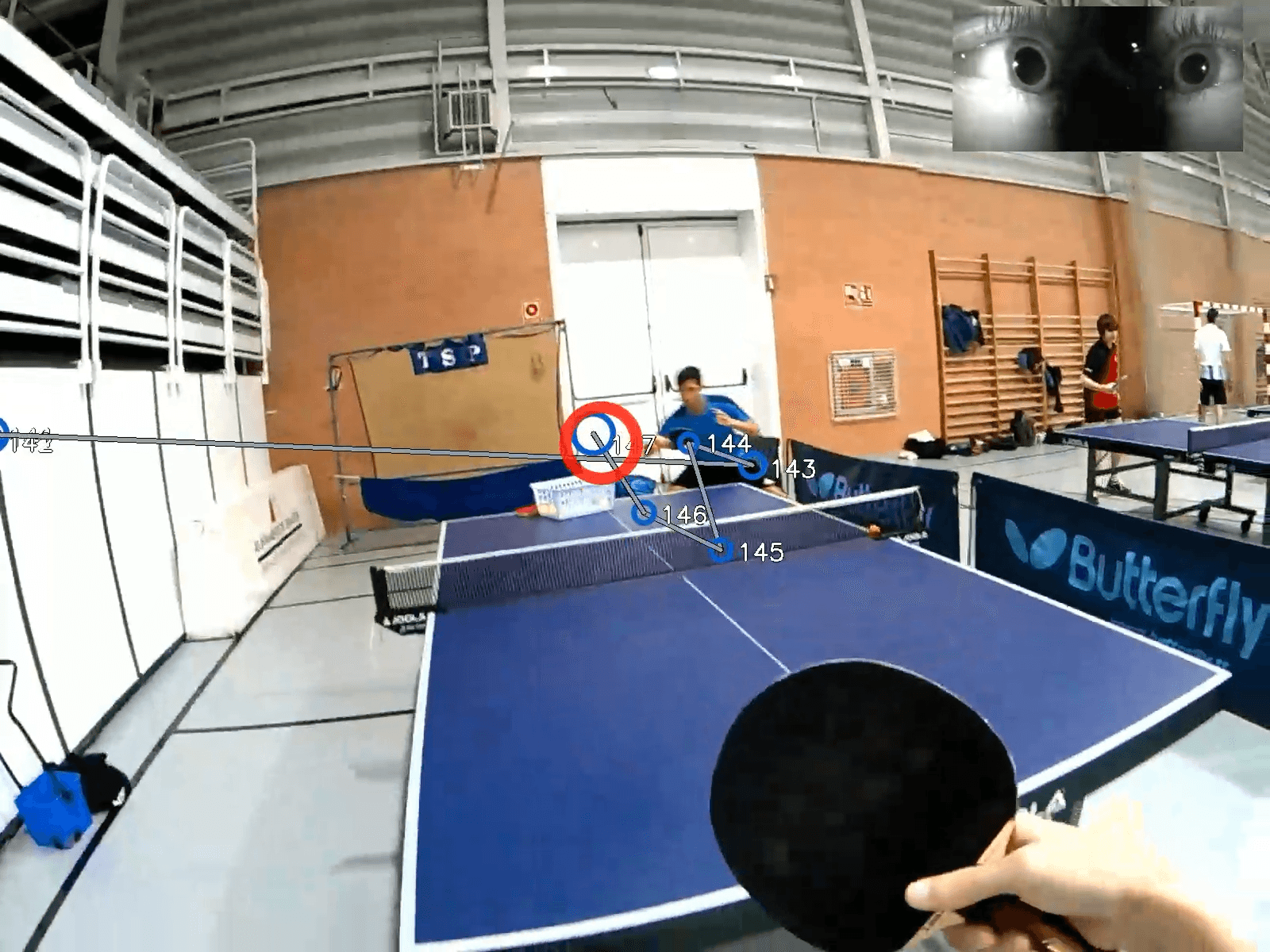
Video still from video below: Eye tracking recording captured with Neon during a live table tennis rally. Courtesy of Alejandro Guiseris Santaflorentina.
Beyond Reflexes: The Visual Demands of Table Tennis
Table tennis is among the fastest ball sports, with rallies unfolding in fractions of a second. At this speed, successful performance depends not only on motor skill, but on highly efficient visual processing. Players must anticipate ball trajectories, read opponent cues, and coordinate perception and action under severe time constraints. Understanding how these visual strategies differ across expertise levels and cognitive profiles remains a central challenge in sports vision research.
Traditionally, this research has relied on laboratory-based paradigms using screens, static stimuli, and head restraints. While methodologically controlled, these setups fail to capture the dynamic, embodied nature of real gameplay. As a result, critical aspects of visual-motor behavior may be overlooked.
Bringing Eye Tracking to the Table
To address this limitation, researchers from the University of Zaragoza conducted a naturalistic eye tracking study during real table tennis rallies. Using the Neon wearable eye tracking system, the team recorded gaze behavior directly on the table and surrounding area, with players holding a paddle (aka a racket) and engaging in continuous forehand–backhand exchanges.
The study included 46 participants divided into four groups: professional table tennis players, amateur players, athletes with Down syndrome, and athletes with other intellectual disabilities. By comparing these groups, the researchers aimed to disentangle the effects of expertise and cognitive function on visual attention strategies during high-speed sport performance.
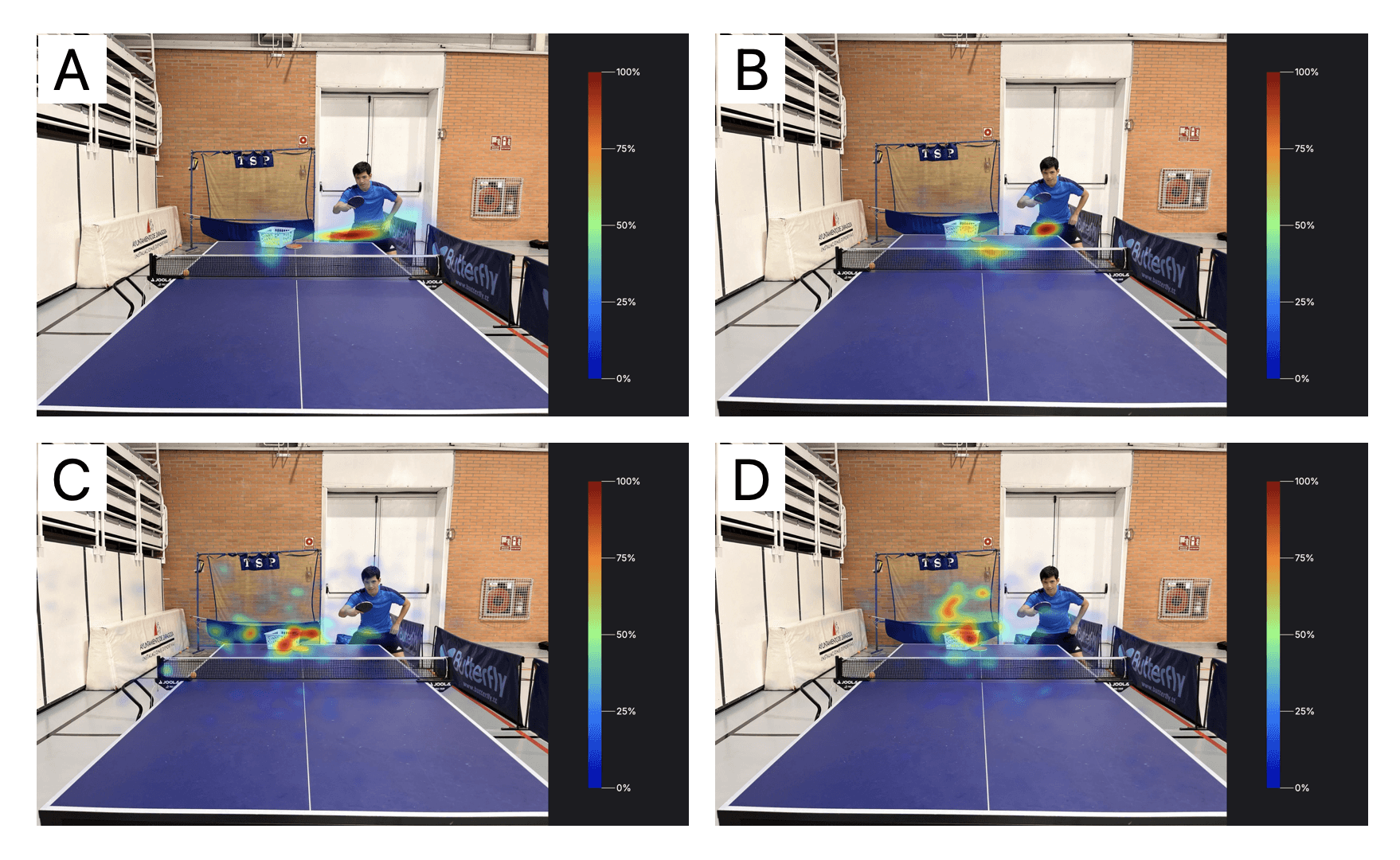
Figure 1: Fixation heatmaps showing visual attention during the game: (A) Professional athletes, (B) Amateurs, (C) Athletes with Down Syndrome, (D) Athletes with other intellectual disabilities. Courtesy of Alejandro Guiseris Santaflorentina.
What Distinguishes Expert Visual Behavior?
Across all groups, fixation duration was strikingly similar, averaging roughly 270 to 300 milliseconds. This challenges the assumption that expertise is linked to longer fixations. Instead, the key differences lay in where and how visual attention was deployed.
Professional players showed a more centralized and anticipatory gaze strategy, focusing on predictive regions of the opponent’s side rather than continuously tracking the ball. In contrast, participants with intellectual disabilities exhibited more dispersed and unstable gaze patterns, with fixations often landing on less informative areas such as the net or table edges.
These differences can be summarized as three visual signatures of expertise:
Efficient visual sampling: Experts used fewer but more precisely targeted fixations, prioritizing anticipation over constant ball tracking. While amateur players and athletes with intellectual disabilities tended to follow the moving ball directly, experts looked at specific, informative cues (like the opponent's contact point or predicted bounce) rather than keeping their "eye on the ball" at all times. This strategy supports earlier processing of the ball’s likely trajectory, reduces unnecessary visual sampling, and optimizes reaction speed under time pressure.
Higher engagement: Professional and amateur players showed larger pupil diameters, around 5.3 millimeters, compared to roughly 4.1 to 4.3 millimeters in athletes with intellectual disabilities. This is consistent with greater attentional engagement during play.
Controlled eye movements: Experts combined fast saccades with stable gaze control, while participants with Down syndrome showed higher saccadic velocity and variability, indicating challenges in gaze stabilization.
Implications for Training and Inclusion
Beyond performance analysis, these findings highlight eye tracking as a powerful tool for inclusive sports training. Rather than categorizing athletes solely by overall ability, coaches can identify specific visual challenges related to anticipation, gaze stability, and attentional control.
Crucially, the results suggest that visual efficiency is trainable. Training programs that emphasize predictive visual cues, rather than continuous ball tracking, may help athletes with intellectual disabilities improve coordination, performance, and engagement with the sport.
Further Resources
Full article: https://www.sciencedirect.com/science/article/pii/S0167945725001307
Research Centers:
Department of Applied Physics, University of Zaragoza, Zaragoza, Spain
Aragon Health Research Institute (IIS Aragón), Zaragoza, Spain