Research Digest
|
Psychology
Can Robots Communicate Intention with a Simple Glance?
Robotics
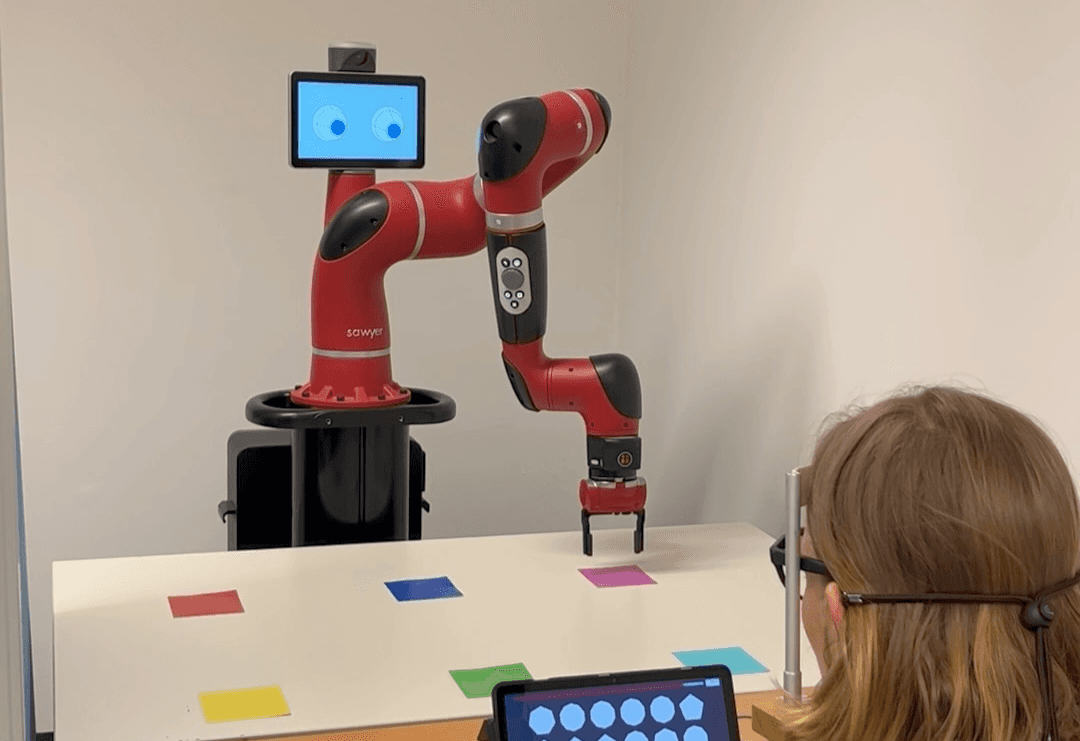
Video still from below: A participant wearing Neon eye tracking glasses during a collaborative task with the CoBot.
Video source: https://osf.io/7pq6m/files/42qbt
The Challenge: Reading a Robot's Intentions
Collaborative robots, or CoBots, are increasingly being deployed alongside human workers. Unlike traditional industrial robots that operate behind safety barriers, CoBots are designed to share the same workspace and cooperate directly with people.
Successful collaboration depends on predictability. When two people work together, a glance is often enough to communicate intentions and coordinate actions. We instinctively follow another person's gaze to anticipate what they will do next. But can the same mechanism work with a robot?
To investigate this question, researchers Lara Naendrup-Poell and Linda Onnasch from the Technische Universität Berlin examined how different visual cues influence human attention, performance, and trust during human-robot collaboration.
Tracking Attention in Real-Time Collaboration
Participants sat face-to-face with Sawyer, an industrial CoBot whose integrated screen displayed abstract anthropomorphic eyes, directional arrows, or no visual cues. Their task was to predict the robot's upcoming movement target as quickly and accurately as possible. Partway through the session, the cues briefly indicated an incorrect target, allowing the researchers to observe how people respond when a robot's communication becomes unreliable.
To understand how participants allocated their visual attention throughout the interaction, the researchers equipped them with Neon eye tracking glasses. Human-robot interaction studies often rely on questionnaires, response times, or video observations after the task. Wearable eye tracking instead provided a continuous record of visual behavior while decisions unfolded in real time.
The researchers analyzed two gaze-derived measures. Time to first fixation on the correct target quantified how quickly attention was guided toward the robot's intended destination. The number and duration of fixations on predefined Areas of Interest (AOIs), the robot's display and the robotic arm, showed which information participants relied on and how their visual strategy changed when the robot's behavior became unreliable. Reliable cues should concentrate fixations on the display. Unreliable cues should drive fixations toward the arm, the only remaining source of accurate information.
The paper reports two studies. The second was a full replication of the first, testing whether the observed patterns would hold in an independent sample.
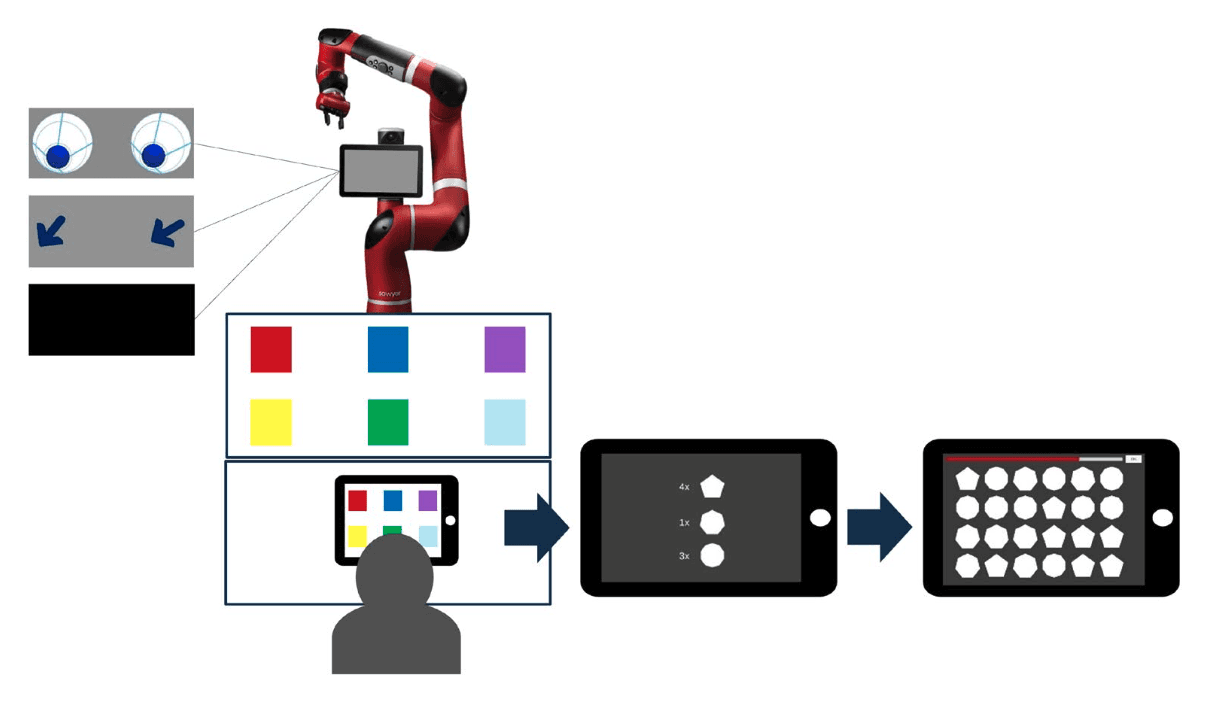
Figure 1: Experimental setup showing the collaborative robot, the visual cues displayed on its screen (eyes, arrows, or no cue), and the participant performing the prediction task. Adapted from Naendrup-Poell, L., & Onnasch, L. (2026). Predictive robot eyes shape visual attention, performance, and trust in interaction with an industrial CoBot. Scientific Reports, 16(1), 14171.
How People Respond to Robot Gaze: Attention, Adaptation, and Trust
The results showed that gaze-like cues can significantly improve human-robot coordination, but only when they are reliable:
Robot eyes guide attention most effectively: Both eye-like cues and directional arrows helped participants anticipate the robot's next movement, though the benefit was larger and more consistent for the eyes. Time-to-first-fixation analyses showed that the anthropomorphic eyes directed visual attention toward the correct target more efficiently than the other conditions. People appear to interpret gaze as an indicator of intention, even when it originates from a robot.
Eye tracking revealed rapid adaptation: When misleading cues appeared, fixation patterns changed immediately. Participants fixated less on the robot's display and more on the moving robotic arm, using its motion rather than the visual cues to anticipate the next action. In other words, they stopped relying on what the robot signaled and returned to watching what it did.
Trust depends on reliable communication: Trust dropped sharply when the cues became unreliable, then gradually recovered once the robot resumed providing correct information, a pattern that replicated across both studies. A rise in trust during the early error-free interaction was visible but did not reach statistical significance. Together with the eye tracking data, these results suggest that people continuously evaluate both a robot's behavior and the reliability of its communication signals during collaboration.
Designing More Predictable CoBots
As collaborative robots become more common in industry, healthcare, and logistics, effective communication will play a growing role in safe and efficient teamwork. The interfaces that signal a robot's intentions will matter as much as its mechanics.
The study offers concrete findings for designers. Even simple gaze-like signals help people anticipate a robot's actions, and they do so more consistently than symbolic alternatives. This gives engineers a basis for designing collaborative robots that communicate their intentions more naturally, making interactions safer, more efficient, and easier to understand.
Equally notable is what the wearable eye tracking revealed along the way. It showed visual attention shifting in real time as participants lost and regained trust in the robot. By measuring when participants first attended to the correct target, and how their fixation patterns moved across different parts of the robot, the researchers uncovered cognitive strategies that questionnaires or performance measures alone would have struggled to capture.
The measures used here also generalize beyond this experiment. Time to first fixation quantifies how quickly a signal captures attention, and fixation counts across a small set of AOIs quantify which information source an operator relies on. Together they form a compact protocol for evaluating any robot communication interface, whether a warning light, a projected path, or an auditory cue.
Further Resources
Full article: https://www.nature.com/articles/s41598-026-50476-4
Research Center: Department of Action and Automation Psychology, Technische Universität Berlin, Berlin, Germany