The Use of Eye-Tracking in Maritime Simulator-Based Training

Research Digest

February 3, 2026

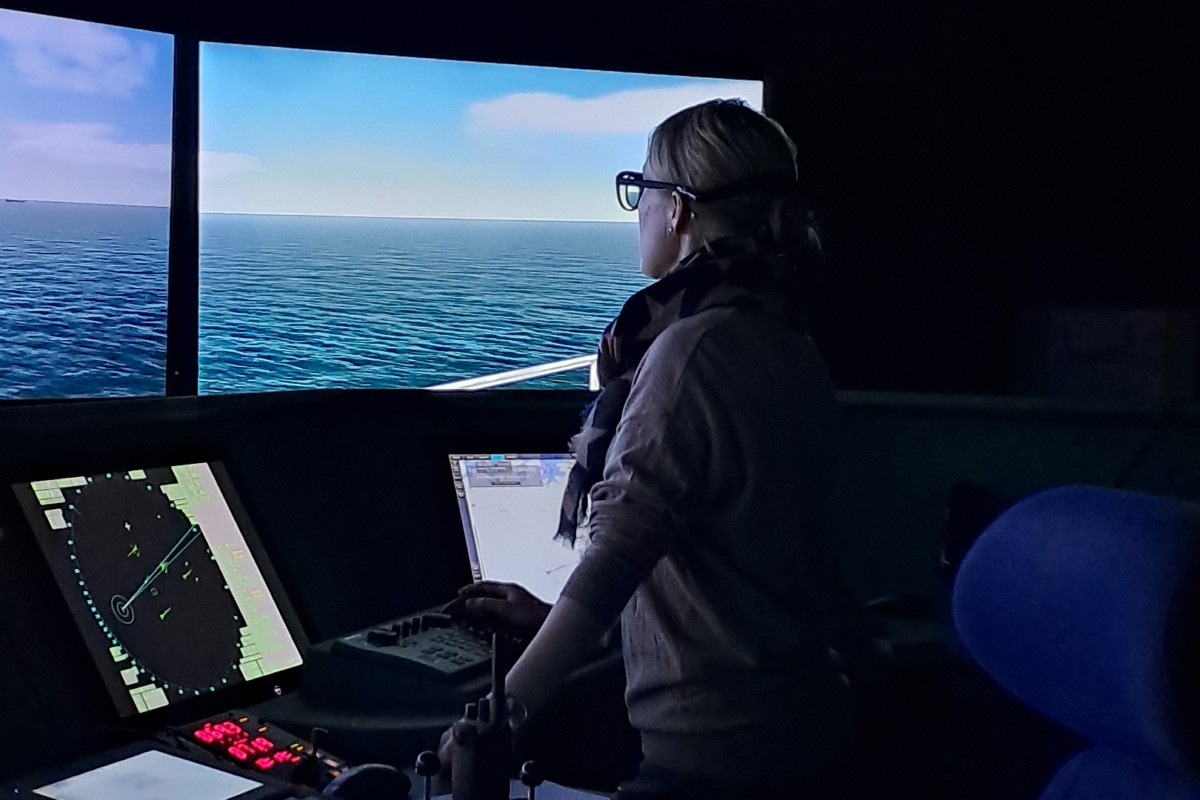
Figure 1: A participant wearing Neon eye tracking glasses during a simulated navigation task. Courtesy of Anne Bouyssou Chen.

Figure 1: A participant wearing Neon eye tracking glasses during a simulated navigation task. Courtesy of Anne Bouyssou Chen.

Figure 1: A participant wearing Neon eye tracking glasses during a simulated navigation task. Courtesy of Anne Bouyssou Chen.

The Human Factor in Maritime Safety

Despite significant advances in technology, the safety of the global shipping industry relies heavily on the human element. Human error remains a significant contributor to maritime accidents, with collisions and groundings often traced back to operational failures.

Navigating a ship through maritime traffic is a complex cognitive task requiring high levels of situational awareness. One must perceive the environment, synthesize information from various instruments, and project future risks. However, traditional training methods often struggle to objectively measure how a trainee builds this awareness.

To bridge this gap, researchers from Novia University of Applied Sciences (Finland) and the Swedish National Road and Transport Research Institute turned to Neon wearable eye tracking to visualize the hidden cognitive processes of navigators.

From the Bridge to the Data: Tracking the Navigator’s Gaze

The study utilized an impressive full-mission bridge simulator to compare the visual strategies of two experienced active officers against seven maritime trainees. Equipped with Neon eye tracking glasses, participants were immersed in a "dense maritime traffic" scenario.

The simulation was designed to test compliance with international collision regulations (COLREGs), specifically forcing participants to manage overtaking and crossing situations without relying solely on automated systems like Automatic Identification System (AIS). By defining specific Areas of Interest (AOIs), such as the radar, the ECDIS (electronic charts), and the outside window, the researchers could quantify exactly where the participants focused their attention during critical maneuvers.
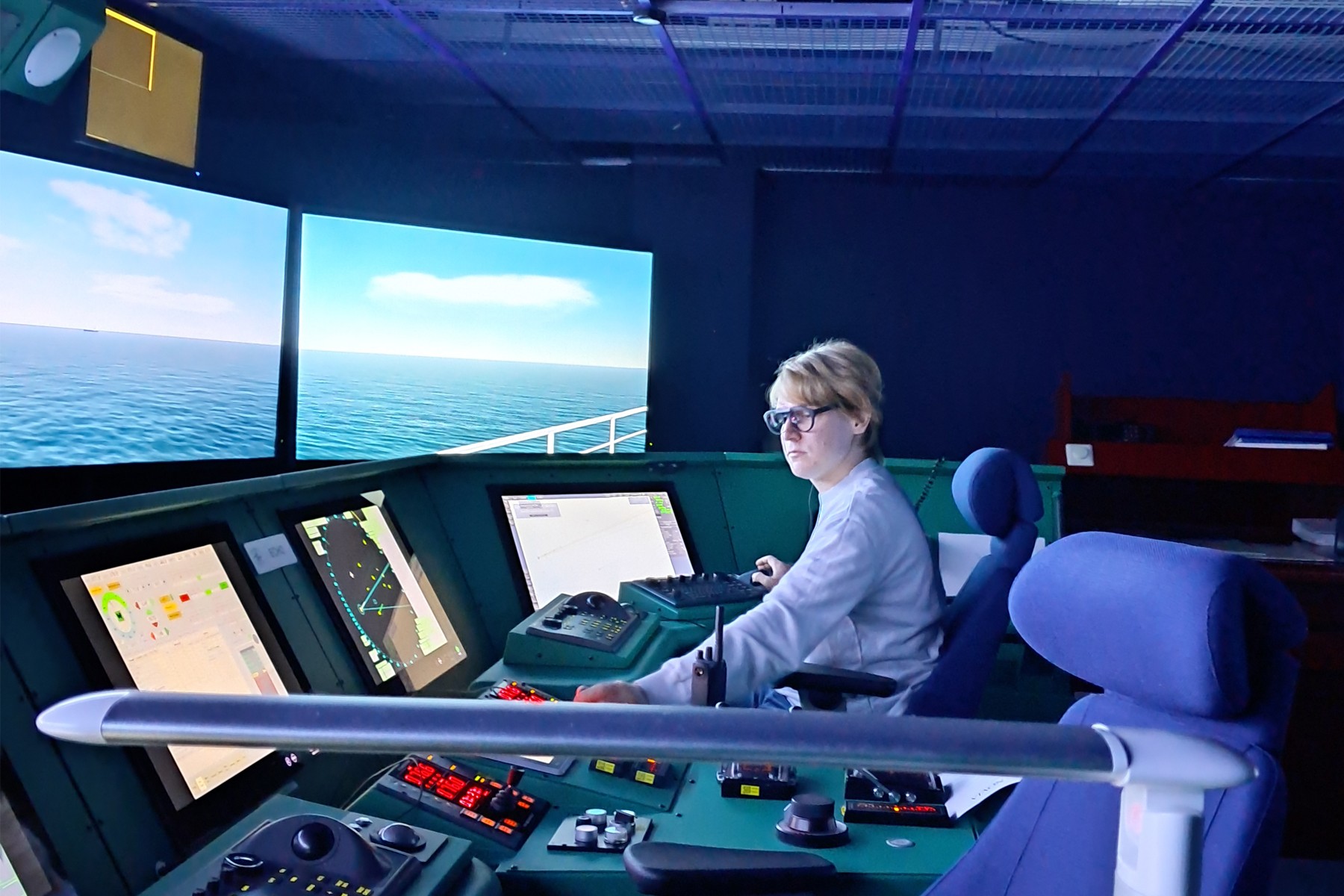
Figure 2: A participant wearing Neon eye tracking glasses while observing the full-bridge simulator, with visual access to the outside window, radar, and ECDIS. Courtesy of Anne Bouyssou Chen.

Key Findings: The Window vs. The Screen

The eye tracking data revealed a distinct difference in how experts and novices gather information. While both groups spent significant time monitoring instruments, the allocation of visual attention varied sharply:

  • Radar Reliance: Both groups spent the majority of their time looking at the radar (68% for students vs. 50% for experts), highlighting it as the primary tool for collision avoidance.

  • The Expert Look-Out: The most prominent difference was in the use of the outside window. Experts spent 41% of their time looking out at the physical horizon for information gathering, compared to only 18% for students.

  • Instrument Fixation: Novices tended to "get stuck" on the screens. The data suggests that experienced navigators rely more on a visual lookout to verify their mental model of the situation, whereas trainees rely heavily on instrument data.

Implications for Maritime Education and Design

These findings provide objective evidence that experts and novices "see" the sea differently. Experts use a more balanced visual scan, integrating real-world visual cues with instrument data to maintain situational awareness.

For Maritime Education and Training (MET), this highlights a potential gap in current instruction: trainees may need specific coaching to reduce screen fixation and increase visual observation of the physical environment. Furthermore, these insights are valuable for the design of Integrated Bridge Systems (IBS). Understanding natural gaze patterns can help engineers position displays and controls to support, rather than distract from, the vital task of looking out the window.

Overall, this research demonstrates that wearable eye tracking is a powerful tool for decoding the "expert eye", offering a path toward safer seas through data-driven training.

Further Resources

Full article: https://openaccess.cms-conferences.org/publications/book/978-1-964867-75-5/article/978-1-964867-75-5_86

Research Centers: Novia University of Applied Sciences, Turku, Finland. The Swedish National Road and Transport Research Institute, Stockholm, Sweden

Research Fundings: The research is part of the Integrating Adaptive Learning in Maritime Simulator-Based Education and Training with Intelligent Learning System (I-MASTER) project supported by the European Union’s Horizon Europe research and innovation programme under grant agreement No. 101060107.

The Human Factor in Maritime Safety

Despite significant advances in technology, the safety of the global shipping industry relies heavily on the human element. Human error remains a significant contributor to maritime accidents, with collisions and groundings often traced back to operational failures.

Navigating a ship through maritime traffic is a complex cognitive task requiring high levels of situational awareness. One must perceive the environment, synthesize information from various instruments, and project future risks. However, traditional training methods often struggle to objectively measure how a trainee builds this awareness.

To bridge this gap, researchers from Novia University of Applied Sciences (Finland) and the Swedish National Road and Transport Research Institute turned to Neon wearable eye tracking to visualize the hidden cognitive processes of navigators.

From the Bridge to the Data: Tracking the Navigator’s Gaze

The study utilized an impressive full-mission bridge simulator to compare the visual strategies of two experienced active officers against seven maritime trainees. Equipped with Neon eye tracking glasses, participants were immersed in a "dense maritime traffic" scenario.

The simulation was designed to test compliance with international collision regulations (COLREGs), specifically forcing participants to manage overtaking and crossing situations without relying solely on automated systems like Automatic Identification System (AIS). By defining specific Areas of Interest (AOIs), such as the radar, the ECDIS (electronic charts), and the outside window, the researchers could quantify exactly where the participants focused their attention during critical maneuvers.

Figure 2: A participant wearing Neon eye tracking glasses while observing the full-bridge simulator, with visual access to the outside window, radar, and ECDIS. Courtesy of Anne Bouyssou Chen.

Key Findings: The Window vs. The Screen

The eye tracking data revealed a distinct difference in how experts and novices gather information. While both groups spent significant time monitoring instruments, the allocation of visual attention varied sharply:

  • Radar Reliance: Both groups spent the majority of their time looking at the radar (68% for students vs. 50% for experts), highlighting it as the primary tool for collision avoidance.

  • The Expert Look-Out: The most prominent difference was in the use of the outside window. Experts spent 41% of their time looking out at the physical horizon for information gathering, compared to only 18% for students.

  • Instrument Fixation: Novices tended to "get stuck" on the screens. The data suggests that experienced navigators rely more on a visual lookout to verify their mental model of the situation, whereas trainees rely heavily on instrument data.

Implications for Maritime Education and Design

These findings provide objective evidence that experts and novices "see" the sea differently. Experts use a more balanced visual scan, integrating real-world visual cues with instrument data to maintain situational awareness.

For Maritime Education and Training (MET), this highlights a potential gap in current instruction: trainees may need specific coaching to reduce screen fixation and increase visual observation of the physical environment. Furthermore, these insights are valuable for the design of Integrated Bridge Systems (IBS). Understanding natural gaze patterns can help engineers position displays and controls to support, rather than distract from, the vital task of looking out the window.

Overall, this research demonstrates that wearable eye tracking is a powerful tool for decoding the "expert eye", offering a path toward safer seas through data-driven training.

Further Resources

Full article: https://openaccess.cms-conferences.org/publications/book/978-1-964867-75-5/article/978-1-964867-75-5_86

Research Centers: Novia University of Applied Sciences, Turku, Finland. The Swedish National Road and Transport Research Institute, Stockholm, Sweden

Research Fundings: The research is part of the Integrating Adaptive Learning in Maritime Simulator-Based Education and Training with Intelligent Learning System (I-MASTER) project supported by the European Union’s Horizon Europe research and innovation programme under grant agreement No. 101060107.

The Human Factor in Maritime Safety

Despite significant advances in technology, the safety of the global shipping industry relies heavily on the human element. Human error remains a significant contributor to maritime accidents, with collisions and groundings often traced back to operational failures.

Navigating a ship through maritime traffic is a complex cognitive task requiring high levels of situational awareness. One must perceive the environment, synthesize information from various instruments, and project future risks. However, traditional training methods often struggle to objectively measure how a trainee builds this awareness.

To bridge this gap, researchers from Novia University of Applied Sciences (Finland) and the Swedish National Road and Transport Research Institute turned to Neon wearable eye tracking to visualize the hidden cognitive processes of navigators.

From the Bridge to the Data: Tracking the Navigator’s Gaze

The study utilized an impressive full-mission bridge simulator to compare the visual strategies of two experienced active officers against seven maritime trainees. Equipped with Neon eye tracking glasses, participants were immersed in a "dense maritime traffic" scenario.

The simulation was designed to test compliance with international collision regulations (COLREGs), specifically forcing participants to manage overtaking and crossing situations without relying solely on automated systems like Automatic Identification System (AIS). By defining specific Areas of Interest (AOIs), such as the radar, the ECDIS (electronic charts), and the outside window, the researchers could quantify exactly where the participants focused their attention during critical maneuvers.

Figure 2: A participant wearing Neon eye tracking glasses while observing the full-bridge simulator, with visual access to the outside window, radar, and ECDIS. Courtesy of Anne Bouyssou Chen.

Key Findings: The Window vs. The Screen

The eye tracking data revealed a distinct difference in how experts and novices gather information. While both groups spent significant time monitoring instruments, the allocation of visual attention varied sharply:

  • Radar Reliance: Both groups spent the majority of their time looking at the radar (68% for students vs. 50% for experts), highlighting it as the primary tool for collision avoidance.

  • The Expert Look-Out: The most prominent difference was in the use of the outside window. Experts spent 41% of their time looking out at the physical horizon for information gathering, compared to only 18% for students.

  • Instrument Fixation: Novices tended to "get stuck" on the screens. The data suggests that experienced navigators rely more on a visual lookout to verify their mental model of the situation, whereas trainees rely heavily on instrument data.

Implications for Maritime Education and Design

These findings provide objective evidence that experts and novices "see" the sea differently. Experts use a more balanced visual scan, integrating real-world visual cues with instrument data to maintain situational awareness.

For Maritime Education and Training (MET), this highlights a potential gap in current instruction: trainees may need specific coaching to reduce screen fixation and increase visual observation of the physical environment. Furthermore, these insights are valuable for the design of Integrated Bridge Systems (IBS). Understanding natural gaze patterns can help engineers position displays and controls to support, rather than distract from, the vital task of looking out the window.

Overall, this research demonstrates that wearable eye tracking is a powerful tool for decoding the "expert eye", offering a path toward safer seas through data-driven training.

Further Resources

Full article: https://openaccess.cms-conferences.org/publications/book/978-1-964867-75-5/article/978-1-964867-75-5_86

Research Centers: Novia University of Applied Sciences, Turku, Finland. The Swedish National Road and Transport Research Institute, Stockholm, Sweden

Research Fundings: The research is part of the Integrating Adaptive Learning in Maritime Simulator-Based Education and Training with Intelligent Learning System (I-MASTER) project supported by the European Union’s Horizon Europe research and innovation programme under grant agreement No. 101060107.