Research Digest
|
UI / UX Research
Through the Eyes of a Child: How Eye Tracking Reveals the Hidden Challenges of Wayfinding
Spatial Navigation
Why Navigation Is Harder for Children
Large commercial spaces like shopping malls are designed with adults in mind. For children, navigating these environments can be challenging. Their spatial awareness is still developing, and visual cues that guide adults may not be as accessible or meaningful to them.
Video of a child navigating through a shopping mall, searching for a vintage car museum. Video not related to the research paper, for demonstration purposes only.
When children become disoriented, the consequences go beyond inconvenience. Confusion can quickly turn into stress, increasing the risk of separation from caregivers. Despite this, most wayfinding research has focused on adults, leaving a gap in understanding how children actually experience these spaces.
Tracking Navigation in a Real-World Setting
To address this, Soyoung Choi from the Institute of Construction and Environmental Engineering of the Seoul National University conducted an eye tracking study in a large commercial complex in South Korea. The study included 51 children aged 4 to 9 and 37 adult women, who were instructed to navigate to a restroom and return to their starting point.
To compare the effects of spatial layout, participants completed the task in two areas: a simpler grid-like floor and a more complex floor with an irregular, radial structure.
Using Pupil Invisible eye tracking glasses, gaze behavior was recorded as participants moved freely through the environments. The data was analyzed in Pupil Cloud using Reference Image Mapper to generate heatmaps and scanpaths, allowing direct comparison of how children and adults visually explored the space.
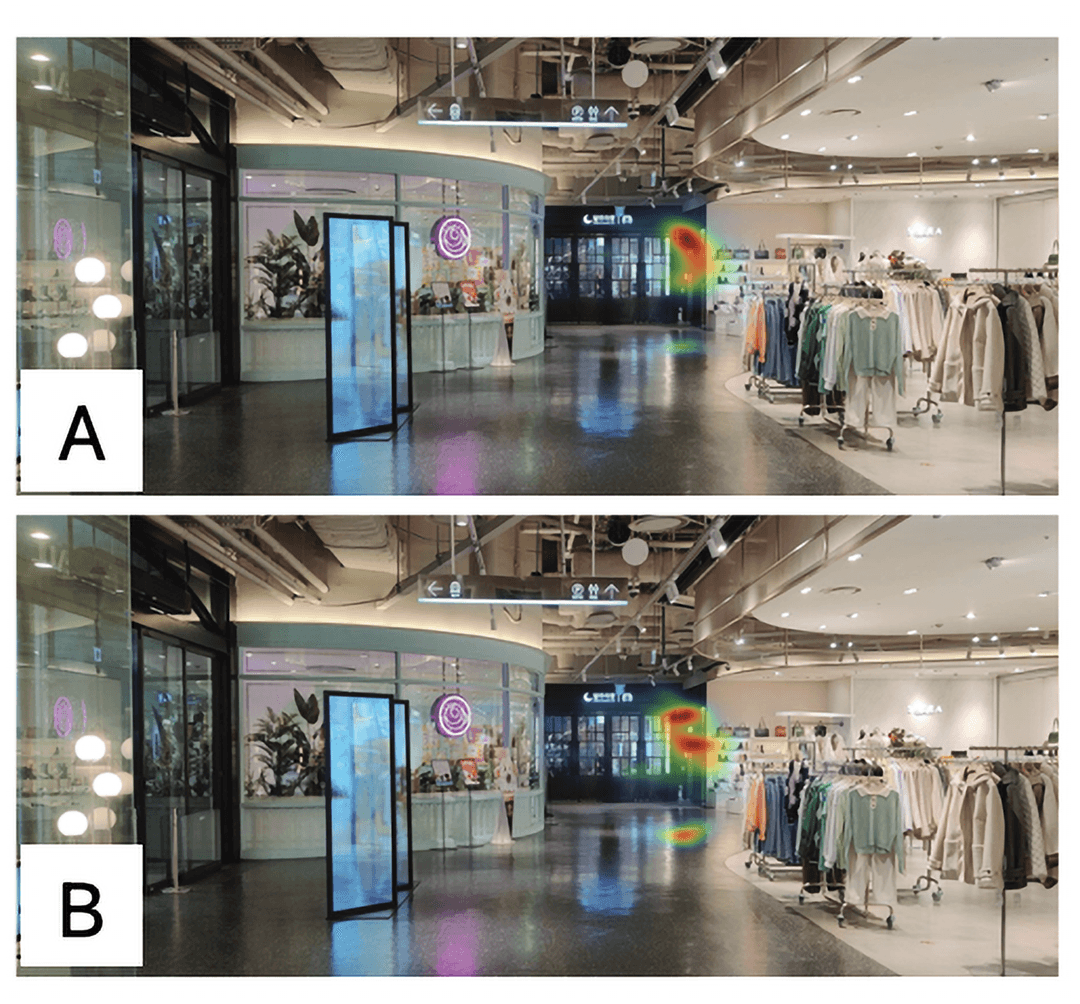
Figure 1: Heatmaps showing how adults (A) and children (B) paid attention to the items in the mall before heading to the restroom. Adapted from Choi, S. (2026). Children’s wayfinding characteristics and influencing factors compared with adults using eye-tracking: Focusing on a complex commercial facility in South Korea. Journal of Asian Architecture and Building Engineering, 1-50.
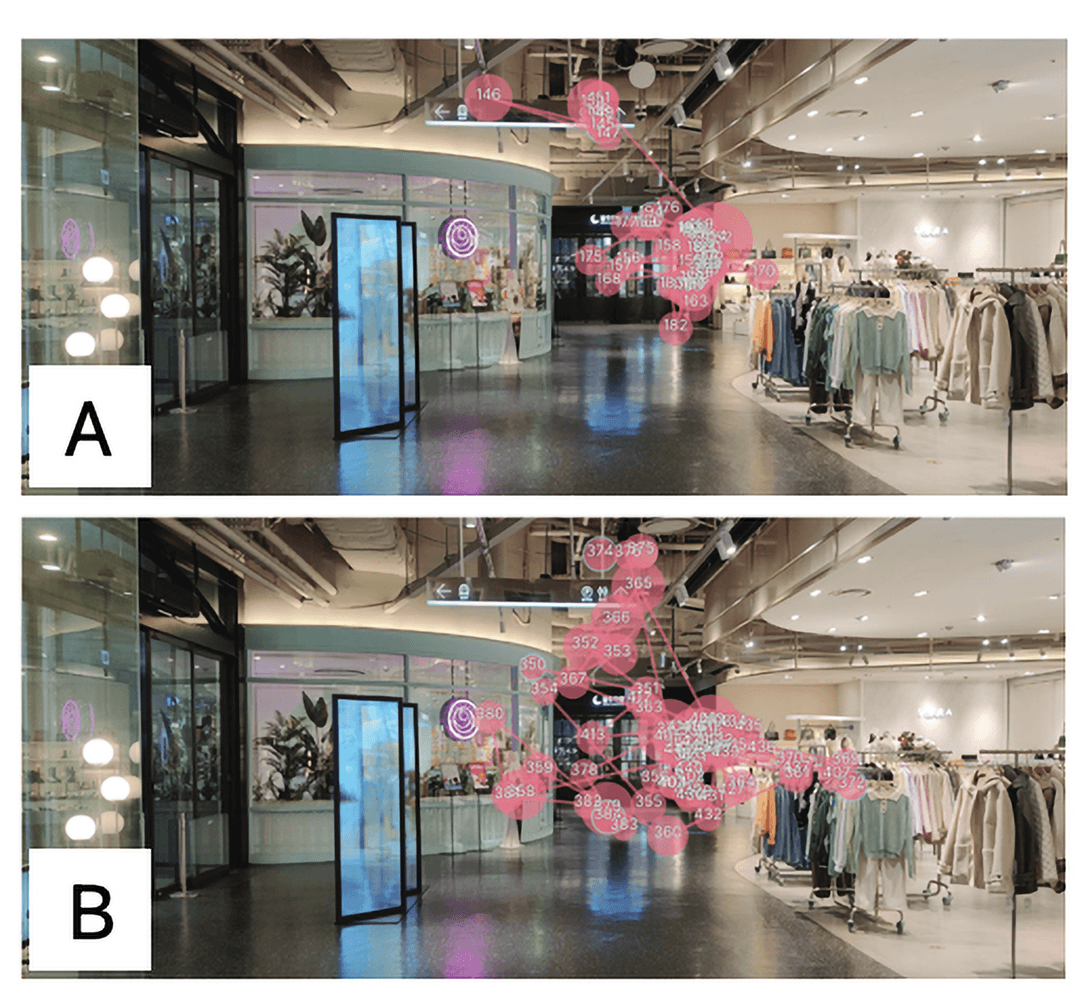
Figure 2: Scanpaths showing how an adult participant (A) and a child participant (B) scanned through the mall before heading to the restroom. Adapted from Choi, S. (2026). Children’s wayfinding characteristics and influencing factors compared with adults using eye-tracking: Focusing on a complex commercial facility in South Korea. Journal of Asian Architecture and Building Engineering, 1-50.
What the Eyes Reveal
The study uncovered clear differences in how adults and children visually navigate complex spaces.
Exploration vs. efficiency: Adults quickly fixated on relevant cues and moved directly toward their destination. Children explored more broadly, scanning larger portions of the environment before deciding where to go. Across both simple and complex layouts, children consistently took longer and walked farther than adults to complete the same navigation tasks, with the largest differences appearing in the complex floor layout.
Looking at eye level instead of overhead: Adults relied heavily on overhead signage, while children focused on elements within their immediate field of view. As a result, children often missed navigational cues placed above them and instead used floor-level guidance cues for navigation.
More visual effort, more distraction: Children produced more frequent fixations overall, indicating greater visual effort during navigation. Their attention was also more easily captured by visually salient objects such as toys, products, and decorative displays. While these elements sometimes acted as memorable landmarks, they also increased distraction and disorientation.
What makes signage work for children: Signs combining pictograms with text proved easier for children to interpret than abstract symbols or text-only information. Visibility also mattered: shelving and large displays frequently obstructed children’s lines of sight, limiting access to directional cues and spatial information.
Together, these findings suggest that children do not simply navigate less efficiently than adults. They rely on fundamentally different visual strategies shaped by their height, attention patterns, and developing spatial awareness.
Designing Child-Friendly Spaces
Children do not navigate spaces the same way adults do. They rely on different visual strategies, focus on cues at their own eye level, and are more easily drawn to distracting elements.
For designers and planners, this means rethinking wayfinding from a child’s perspective by placing signage within their field of view, combining pictograms with text, reducing visual obstructions, and using clear, recognizable landmarks.
Wearable eye tracking makes these differences visible, offering a practical way to design environments that are safer, more inclusive, and easier to navigate for everyone.
Further Resources
Full article: https://www.tandfonline.com/doi/full/10.1080/13467581.2026.2620931
Research Centers:
Institute of Construction and Environmental Engineering, Seoul, South Korea
Seoul National University, Seoul, South Korea