Research Digest
|
Psychology
What Our Eyes Reveal About Ancient Pottery Design
Art & Architecture
Psychology & Behavior

Image: A participant wearing Pupil Core while observing a ceramic vessel. The image is illustrative and not part of the study. Source: the XSCAPE project website (https://xscape-project.eu/en/), which funded the research.
Looking Beyond Pottery Styles
For more than a century, archaeologists have studied pottery to reconstruct the lives of past societies. Differences in vessel shape, decoration, and manufacturing techniques reveal how communities exchanged ideas, developed technologies, and expressed cultural identities.
But one important question has remained largely unexplored. How did people actually perceive these objects?
Archaeological methods can classify pottery and describe its stylistic evolution, but they cannot measure which visual features attract attention or how decorative designs shape perception. Researchers often infer an object's cultural importance from its appearance, yet these interpretations rarely draw on evidence of how people actually look at the artifacts.
To address this gap, researchers from Kiel University combined archaeology with wearable eye tracking to investigate how modern observers visually explore prehistoric pottery from central Germany. Earlier work had tracked eye movements over photographs of replica pottery. This study is among the first to measure visual attention across a 5500-year sequence of authentic vessels, asking whether stylistic change over time also changed how much attention pottery commands.
Tracking Attention in the Museum
The study was conducted at the State Museum of Prehistory in Halle, Germany, where 36 participants viewed 41 ceramic vessels dating from approximately 5500 BCE to 1 BCE. Participants fell into three groups, defined by their familiarity with the objects. They were archaeologists, people experienced in ceramic production, and individuals with no prior knowledge of prehistoric pottery.
Each vessel was viewed freely for 15 seconds from a distance of 80 cm, presented in profile inside a box under constant LED lighting. Vessels were grouped by size and their order randomized. These constraints were deliberate. Presenting objects in isolation limited the influence of surrounding context, free viewing avoided pushing experts into task-driven search strategies, and showing the vessels in sequence meant that attention was shaped by comparison across the assemblage rather than by any single pot.
The researchers recorded each participant's visual behaviour continuously using Pupil Core wearable eye tracking glasses, which provided three complementary measures. Gaze position revealed how viewers explored each vessel. Fixations identified the elements that held sustained attention. Pupil diameter gave an indicator of cognitive effort.
What the Eyes Reveal About Ancient Design
The eye tracking recordings revealed that decoration, rather than vessel shape, was the strongest driver of visual attention.
Decoration attracts attention: Across all participant groups, viewers consistently spent more time looking at engraved patterns, punctures, and other decorative motifs than at the overall form of the vessels. Characteristics such as size, brightness, or silhouette played a comparatively minor role in determining where people looked.
Early Neolithic pottery was the most engaging: The most visually engaging pottery belonged to the Linearbandkeramik (LBK) and Stichbandkeramik (SBK) cultures of the Early Neolithic. These vessels featured dense geometric decorations that produced both the longest fixation durations and the largest pupil responses, suggesting they required greater visual processing and elicited stronger cognitive engagement.
Later pottery attracted less attention: By contrast, pottery from the Late Iron Age generally attracted shorter fixations and smaller pupil responses. These vessels tend to be more standardized, symmetrical, and visually uniform, making them easier to process at a glance.
Perhaps most interestingly, these patterns emerged regardless of archaeological expertise. While specialists and non-specialists differed in some aspects of their viewing behavior, the decorative complexity of the vessels consistently guided visual attention across participants.
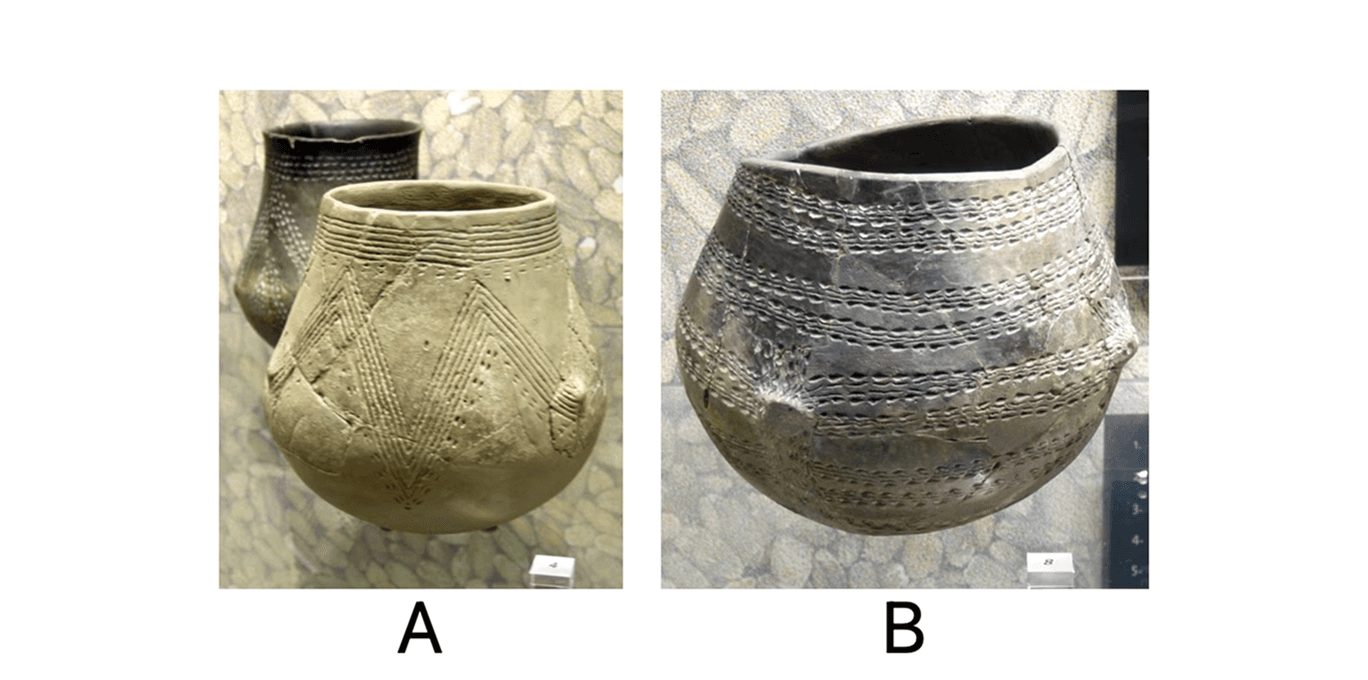
Image: (A) Ceramic vessel from the Linearbandkeramik (LBK) tradition. (B) Ceramic vessel from the Stichbandkeramik (SBK) tradition. Both images adapted from photographs by Wolfgang Sauber, licensed under CC BY-SA 4.0 (https://creativecommons.org/licenses/by-sa/4.0/), via Wikimedia Commons.
Material Culture and the Human Mind
The findings suggest that pottery decoration was more than simple ornamentation. Highly decorated Early Neolithic vessels may have been particularly effective at attracting attention, making them powerful tools for communicating identity, social affiliation, or cultural traditions. As societies changed and new forms of material culture emerged, pottery appears to have become less visually distinctive, potentially reflecting shifts in its social role.
One point deserves emphasis. Every participant was a modern observer in Germany, and the authors are explicit that they do not claim prehistoric people looked at these pots the same way. The methodology choices described above were made to reduce, not eliminate, the influence of modern cultural and expert habits of looking. Extending the work to culturally diverse populations, including people who make and use such vessels today, is the team's stated next step.
What the eye tracking contributes is a way to measure something archaeology has long asserted but never quantified: that some objects captivate and others do not. The protocol is compact and portable. Fixation maps show where attention lands. Fixation duration and pupil diameter, used together, estimate how hard an object is to process. The same three measures would work on any artefact class, or on any question about which visual features of an object attracts and holds a viewers attention.
More broadly, the study demonstrates how wearable eye tracking can complement traditional archaeological analysis. Rather than relying exclusively on expert interpretation, researchers can now quantify how people visually interact with artifacts and test long-standing hypotheses about design, communication, and cultural evolution using objective behavioral data.
Further Resources
Research Centers:
Institute of Pre- and Protohistoric Archaeology, Kiel University, Germany
Institute of Psychology, Kiel University, Germany