Guides
What makes a good eye tracker? Part 3: Robustness

Robustness describes how well an eye tracker maintains measurement availability and performance as conditions change. In real-world recordings, the wearer, device, task, and environment may all vary. Below, we explain the sources of this variation, how NeonNet handles them, how Neon was tested outside the laboratory, and how robust measurements can preserve recording time and reduce interruptions.
Built for real-world variation
Neon was designed to handle several important sources of real-world variation, including headset slippage, lighting, eye appearance, and gaze angle.
Headset slippage
Headset slippage occurs when the frame shifts relative to the wearer. It may happen gradually as the glasses slide down the nose, or suddenly when the wearer adjusts, removes, or puts them back on. Physical activity, talking, and changes in facial expression can all alter how the frame sits. Each change in position means the eye cameras see the eyes from a different viewpoint.
Lighting
Lighting may change throughout a recording as the wearer moves between locations or turns towards a different light source. Moving between indoor and outdoor environments can create particularly large changes in what the eye cameras receive.
Direct sunlight presents an additional challenge because it contains strong infrared light and introduces reflections on the cornea that are not present in a controlled indoor environment.
Eye appearance

There is no standard eye appearance, either. Eye shape, eyelid opening, contact lenses, mascara, eyeliner, and artificial eyelashes all affect what the cameras see.
Eye appearance can also change during a recording. Squinting narrows the eyelids and may cause the eyelids or eyelashes to cover more of the eye and occlude the pupil.
Gaze angle

People routinely look far to the side, upwards, or downwards without turning their head. As the eye rotates, the pupil and surrounding features move within the cameras’ view. At extreme gaze angles, the eyelid may also cover more of the eye and pupil.
How Neon overcomes these challenges
NeonNet was trained on a diverse collection of eye images spanning these sources of variation. This helps it generalise to new people and situations. Because it interprets the overall appearance of the eye, it can use the information that remains visible rather than requiring a clear, unobstructed view of a single feature such as the pupil.¹
Neon's 100° by 80° gaze range covers the full field of human vision. Neon is also glint-free, so it does not require corneal reflections to remain distinguishable as illumination changes. This helps it maintain measurements in direct sunlight, which is in contrast to glint-based systems, where direct sunlight can wash out the glints completely, diminishing tracking performance.
The calibration-free operation article explains NeonNet’s wider measurement approach. The next section examines how Neon performed when these sources of variation were included in its evaluation.
How Neon was tested outside the laboratory
The Neon Accuracy Test Report evaluates calibration-free gaze in both controlled and real-world settings. Its in-the-wild evaluation included 402 randomly selected participants recruited from 53 countries. They were between 18 and 85 years old, and none of their data had been used to train NeonNet. No restrictions were placed on eye appearance, makeup, or headwear. The dataset included pronounced eye makeup, artificial eyelashes, facial masks, and headscarves.¹
Participants' recordings were made whilst looking at known targets in everyday indoor and outdoor settings. Outdoor recordings often included direct sunlight from different directions. Viewing distances ranged from 0.3 m to 4 m, and three different Neon frames were used. The recordings also covered a wide range of gaze directions.¹
Between recordings, participants deliberately moved Neon on their face. This created varied and realistic device positions rather than testing the eye tracker only in its initial fit.¹
Performance changed little across tested conditions
Without offset correction, median gaze error was 0.4° greater outdoors than indoors. With offset correction, the difference was 0.2°, and median gaze error decreased by 0.6° in both environments.¹
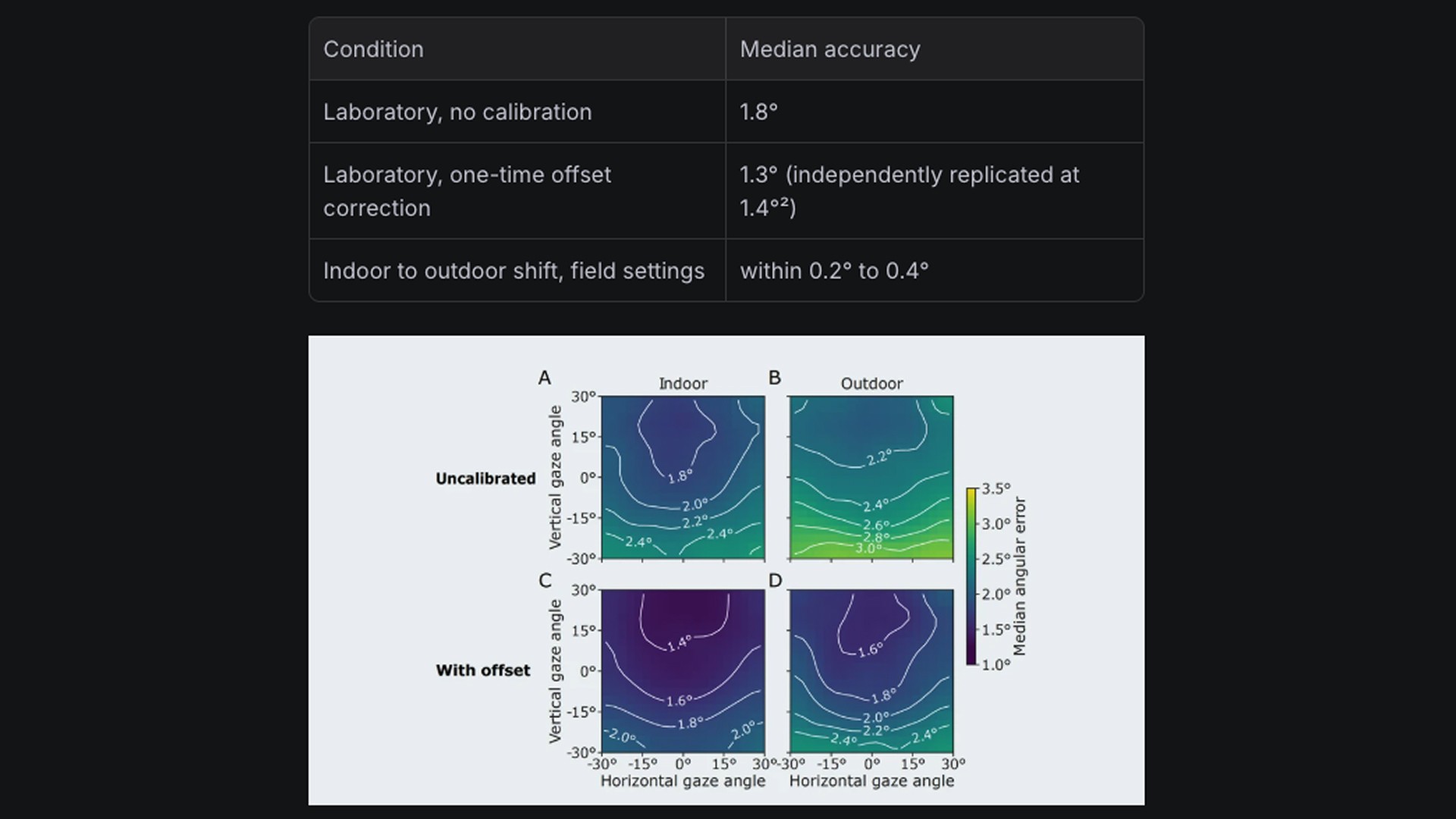
A single person-specific offset was calculated from one set of recordings and applied unchanged to separate evaluation recordings involving different device positions. Within the conditions tested, the one-time correction therefore remained effective as lighting and headset position changed.¹
These population results do not mean that performance was unchanged for every participant or sample. They show that Neon's performance changed only slightly when real-world variation was included in the evaluation rather than excluded from it. The Accuracy article explains how to relate angular error to the requirements of a particular application.
Fewer interruptions as conditions change
For research, robustness can preserve usable recording time as the participant, device, and surroundings change. This matters particularly when repeating a procedure or replacing a participant would be difficult.
Beyond research, the same continuity matters in industrial workflows and systems that use gaze as an input. Measurements can continue as work moves between environments or activities, reducing the need for specialist intervention and helping interfaces, monitoring workflows, or automated processes continue without interruption.
Real-world demands often converge
Most everyday tasks take place in complex, changing environments. Even routine work may involve walking, bending, turning the head, looking between nearby and distant objects, and moving through areas with different lighting. The frame may also shift as the wearer moves or adjusts it. These variations occur together and continue changing throughout the task rather than appearing as isolated test conditions.
Extreme activities amplify these demands
Some activities take the same conditions much further. A kart racer may look through the apex of a corner while contending with high speed, vibration, rapid head movement, sweat, and changing sunlight. A baseball player may track a ball pitched at up to 100 mph while squinting into low-angle sunlight and looking near the edge of the measurable range. Many eye trackers fail under this combination of demands, even if they perform well in controlled tests.
In repeated trials under these combined conditions, Neon has continued to return accurate and robust gaze measurements.
Where to go next
This article is part of a series exploring what makes a good eye tracker. Related topics include:
¹ Baumann & Dierkes, Neon Accuracy Test Report, Pupil Labs, 2026. doi:10.5281/zenodo.18504792
See the conditions Neon was validated in.
Working in demanding field conditions? Tell us about it on Discord.