Guides
What makes a good eye tracker? Part 4: Data Streams
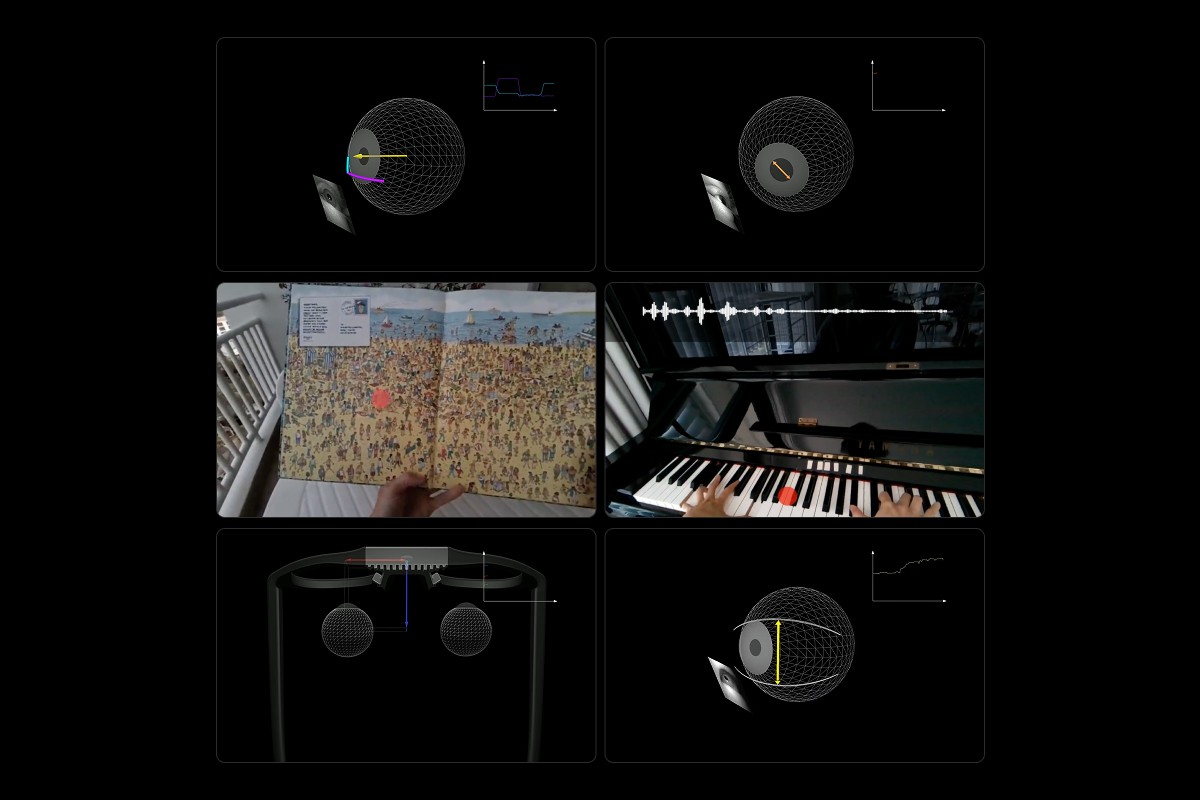
Neon recording playback in Pupil Cloud; fixations, blinks, events, eyelid aperture, pupil size, and audio track, shown in the timeline.
A gaze point shows where someone is looking, but many research and industry applications require more than that. How demanding was the task? Did the participant blink at a critical moment? How tired did they become? How did the two eyes coordinate when looking near and far? Each question needs a different signal.
Neon measures gaze along with pupil size, the position and orientation of each eye, eyelid opening, head movement, video, and audio, and more. Each forms a separate data stream. Below, we explain what these streams mean, how they can be used, and why their sampling rates matter.
Gaze
Neon's gaze signal is a frame-by-frame measurement showing where someone was looking. Each measurement is reported as a position in the scene camera image and as horizontal and vertical angle relative to the camera.¹
By default, Neon combines images from both eyes to measure gaze. If one eye is closed or obstructed, it switches to a monocular measurement from the other eye. For work that requires gaze to be isolated to one eye, either the left-eye or right-eye measurement can be selected as the primary signal.²
Neon's gaze signal can be used directly. Software can respond to it in real time, while recorded gaze positions can be mapped onto objects, surfaces, or areas of interest. The resulting gaze path can show how someone looked around an interface, image, product display, or wider scene.
Fixations and Saccades
The gaze signal is also commonly used to derive fixations and saccades. Fixations are periods of looking at a target, while saccades describe the rapid shifts between them. Classifying the signal into these events makes it possible to examine variables such as their duration, sequence, and size using documented operational definitions.
For example, a technician training paradigm might use gaze positions to identify which components of an engine someone viewed, fixation duration to measure how long they looked at them, and saccades to describe how they moved between them. The same measures can describe visual-search strategies in driver hazard, surgical training, and usability tasks.
Neon’s fixation detector was designed for wearable eye tracking, where head movement complicates classifications. When someone fixates a target while turning their head, the eyes rotate in the opposite direction via the vestibulo-ocular reflex (VOR). Fixation detectors built for stationary settings can struggle in this scenario and misclassify the eye movements. Neon compensates for the VOR by using scene-video and IMU measurements, while adapting its detection threshold as head movement changes.³ Neon then treats the gaps between detected fixations as saccades.³
Measuring 3D eye poses
Gaze describes the resulting direction of looking. A 3D eye pose characterises information about the position and orientation of each eye individually. Neon provides this for each eye, where position is reported in millimetres relative to the scene camera, and orientation describes the direction of the eye’s optical axis.¹
Separate measurements preserve differences between the eyes. They can show binocular coordination and vergence as someone looks between near and distant objects. Differences in eye orientation can also provide information about eye misalignment, such as that seen in strabismus, and other eye conditions.
Pupillometry
Pupil diameter changes in response to light and can also vary with mental effort. Pupillometry has been used to study workload in simulated piloting and driving, and listening effort in audiology. A team might, for example, compare pupil responses while operators use two versions of a control panel.
Measuring pupil diameter with a wearable eye tracker requires accounting for changes in viewing geometry. The pupil looks narrower when the eye turns and larger or smaller when the camera moves closer to or farther from it. These viewing effects can change the pupil’s size in the image even when its physical diameter has stayed the same.
Neon addresses this by combining machine learning with a physical model of the eye’s geometry and optics. This allows it to measure pupil diameter in millimetres rather than the pupil’s size in pixels. Neon’s pupillometry report tested this measurement across changes in gaze angle and module position. Apparent pupil size in pixels changed substantially, while the physical pupil-diameter measurement remained largely stable. The report also reproduced established responses to light and task difficulty.⁴
This makes pupillometry more practical outside a tightly controlled laboratory. Participants can move their eyes and head naturally, and the glasses can shift during use, without these changes in viewing geometry being mistaken for changes in pupil diameter.
Eye openness and blinks
Neon measures the opening between the eyelids for each eye and derives blink events from this continuous signal. Blink events show when a blink occurred and how long it lasted. The underlying openness signal also shows how fully the eyes closed.³ These signals enable a multitude of research and use-case avenues:
Attention, workload, and fatigue
People may suppress blinks when they need to take in visual information, while blink rate can increase during mentally demanding tasks that require less visual attention.
Professional formula car drivers, for example, suppressed blinks during periods of high cornering acceleration and braking. Blink duration and prolonged eye closure can also provide information about fatigue. Both have been associated with impaired driving performance following sleep deprivation.
Eye openness can also be used to calculate PERCLOS⁵, the proportion of time the eye is at least 80% closed. It is used when monitoring alertness and drowsiness.⁵
Using blink timing and eye openness
Blinks produce electrical artefacts in EEG recordings. Synchronised eye tracking can identify when they occur, helping researchers remove their contribution or exclude affected periods.
Gaze data can also become unreliable while the eyelids cover the eyes. Blink events allow these periods to be filtered out.⁶ The continuous openness signal also preserves partial closures, which are useful when studying blinking during activities such as reading or screen use in dry eye research.
Understanding what happened around the wearer
Scene video, audio, and head movement connect eye measurements to the surrounding activity.
Scene video and eye videos
Neon’s scene camera records a forward-facing view of the environment, while two infrared cameras record the eyes.⁷
The scene video shows what was present at each measured gaze position. For example, in a marketing study, a gaze overlay when combined with scene context reveals which products attracted the attention of a shopper.
Scene and eye videos are useful beyond viewing them directly. They can also be processed with computer vision algorithms. Pupil Labs’ Alpha Lab includes examples that use YOLO to identify objects, GPT to describe scenes, and other tools to map gaze onto moving objects, body parts, screens, and 3D spaces.⁵ These combinations can support applications such as reading text someone is looking at or describing an object in front of them.
The raw eye videos can be used to corroborate different pupil detection or blink tracking algorithms, or even to develop your own.
Audio
Neon can record audio alongside the scene video.³ In a music sheet reading experiment, a participant’s eye movements can be reviewed alongside their music performance.
Audio also supports studies involving several people. Neon can synchronise gaze, scene video, and audio accross multiple wearers, allowing researchers to examine mutual gaze, shared attention, and turn-taking across participants.⁵
Head movement, orientation, and location
Neon’s inertial measurement unit contains an accelerometer, gyroscope, and magnetometer. A fusion engine combines their measurements to calculate orientation relative to gravity and magnetic north, reported as a quaternion or as pitch, roll, and yaw.³
Because the module is fixed to the glasses, these measurements describe movement of the wearer’s head. Combining them with gaze shows whether a change in viewing direction came from the eyes, the head, or both.
IMU measurements support work on head stability and posture in sports biomechanics, gait and fall-risk studies, and coordination between eye and head movements. In workplace research, they can show how an operator moves between a display, tools, and the task itself.
Location can be added to this account. The Alpha Lab GPS guide combines gaze and IMU measurements with GPS to show the wearer’s route, position, head orientation, and gaze direction on a map.⁵ A Neon Player plugin provides a similar linked map and can display speed, acceleration, elevation, and heart rate when available.⁸
Using the data in real time
The same streams can be used during an activity as well as reviewed afterwards. A coach might follow a live gaze overlay, a gaze-controlled interface might respond when someone looks at a control, and a workplace system might record which components were viewed during each stage of a task.
Neon Monitor provides a browser-based view of the live scene video and gaze overlay. It can switch between connected devices, control recordings, and mark events.⁹ A VPN can extend this connection over the internet, allowing a recording to be monitored securely from another location.¹⁰
The Real-Time API gives other software access to Neon’s measurements. It can also control recordings, mark events, and synchronise with other devices.¹¹ An assembly station could, for example, record gaze and mark when a tool was activated, placing the worker’s gaze and actions on the same timeline.
Why sampling rate matters
Sampling rate describes how many measurements are recorded each second. At 200 Hz, a new measurement is recorded every five milliseconds.
Consider a saccade lasting 30 milliseconds. At 200 Hz, about six measurement points fall within the movement. At 50 Hz, there may be only one or two. The denser sequence makes it easier to determine when the movement began and ended, how far the eyes moved, and how their speed changed.
Neon measures gaze, pupil diameter, eye openness, and the pose of each eye at up to 200 Hz. This places the eye measurements on the same fine-grained timeline.³ The IMU records at 110 Hz, a rate suited to capturing head movement in human movement studies, while the scene camera records at 30 Hz.⁷
Some applications also need video of very fast events. Neon can be combined with a separate high-speed camera using the Alpha Lab Egocentric Video Mapper⁵. The tool synchronises the recordings afterwards and maps the 200 Hz gaze signal onto the external footage while preserving its frame rate. This can be useful when studying fast projectiles in sports such as baseball or clay shooting.⁵
Choosing the data streams a task needs
The starting point is what needs to be measured or understood. A coach may need gaze and video to review an athlete’s technique. A UX team may combine fixations with spoken feedback. An audiology study may examine pupil responses during listening, while a developer building gaze controls needs measurements quickly enough for the interface to respond.
A good eye tracker should provide the relevant data, explain how it is measured, and make it available at a suitable rate. Combined with the accuracy and robustness discussed earlier in this series, this breadth of measurement allows the same wearable eye tracker to support research, coaching, human factors, product development, and real-time applications.
Making use of these data is the next step. Neon provides ready-to-use tools for recording, visualising, and analysing its data streams. Its open-source libraries and APIs also provide access to the raw data for custom analysis and integration with other tools. Later articles in this series will explore these different ways of working with Neon.
Where to go next
This article is part of a series exploring what makes a good eye tracker. Related topics include:
¹ Pupil Labs, Neon Recording Format.
² Pupil Labs, Gaze Mode.
³ Pupil Labs, Neon Data Streams.
⁴ Pfeffer & Dierkes, Neon Pupillometry Test Report, Pupil Labs, 2024.
⁵ Pupil Labs, Alpha Lab.
⁶ Pupil Labs, Pupil Labs Blink Detector, 2023.
⁷ Pupil Labs, Neon Technical Specifications.
⁸ Pupil Labs, Neon Player Plugins.
⁹ Pupil Labs, Monitor Your Data Collection in Real-Time.
¹⁰ Pupil Labs, Using a VPN for Remote Data Collection.
¹¹ Pupil Labs, Neon Real-Time API.
Read the white papers behind Neon’s fixation, blink, and pupillometry data.
Building something with the Real-Time API? Ask on Discord.