Guides
What makes a good eye tracker? Part 5: Modularity and adaptability

One module, many frames
A wearable eye tracker has a physical form as well as a measurement system. Its size, shape, fit, and compatibility with other equipment all affect where and how it can be used. In this article, we explain how Neon’s modular design makes the system fully adaptable, opening the door to diverse avenues of research and industry applications.
The frame should fit the application
In a conventional design, the eye tracker and the glasses are a single object. The cameras and sensors are built into one particular frame, and the form cannot be changed independently.
This is limiting because a single frame is built around a set of assumptions about head size, how much the wearer will move, and what other equipment they will wear at the same time. A frame designed for a seated adult in a lab may not fit a young child. It may not hold its position during sport. It may not sit well under a VR headset or an EEG cap.
A fixed frame design has no way to adapt to a study that falls outside the assumptions it was built around. The study either changes to fit the eye tracker, or the user makes do with a poor fit, if the eye tracker can be used at all.
Neon’s modular approach

We set out to build an eye tracker that could adapt more flexibly to the diverse applications our users were working on. This led us to design Neon as a modular system: the eye tracking module is separate from the frame and connects to it through a small mounting component called the nest.
The module is a single compact unit containing all the cameras and sensors, including two infrared eye cameras, a scene camera, an inertial measurement unit, stereo microphones, and infrared illuminators. It is encased in biocompatible silicone for water and sweat resistance.¹
The nest can be incorporated into a wide range of frame designs, allowing the module to be moved from one form factor to another.
The same data, whichever frame you use
Because every frame holds the same eye tracking module, the same NeonNet model runs and the same accuracy applies whichever frame is used.¹ Choosing a frame is therefore a question of fit and setting, separate from data quality.
This has real consequences for users. One eye tracker can be used in studies that a fixed design cannot, an athlete in motion, a young child, a participant using a VR headset, a field site requiring safety equipment. Because every frame produces the same output, recordings from all of them share one data format and are comparable. A group running several kinds of study can analyse them with the same pipeline and compare results across contexts, including between real-world and VR settings.
What the range of frames covers
With the frame independent of the module, the available options can follow the shape of the research rather than constrain it. Broadly, they fall into these areas.
Naturalistic and behavioural research with frames that look and feel like ordinary glasses, so participants and bystanders behave normally.
Sport and other high-movement research using frames built around an integrated headband, which hold their position through running, jumping, and contact.
Paediatric research with frames sized for children as young as two. This matters alongside Neon’s calibration-free measurement, because calibration can be more challenging to coordinate with young children.
Research involving participants who need vision correction using frames with integrated prescription lenses, either through a quick-exchange kit or custom optician-fitted lenses.
Multimodal research, combining eye tracking with EEG, motion capture, or other headgear, using a minimal frame designed to sit underneath other equipment without competing for space. Frames with integrated motion-capture reflectors are also available.
Industrial and field research that requires protective equipment using frames built around certified safety eyewear.
For a full overview of every available frame, see: A frame for every eye tracking application.
Building your own frame
Where none of the standard frames fits an application, the user does not have to wait for Pupil Labs to design one. The Neon module’s geometry, CAD models, and schematics are published openly, so researchers, industry users, and partners, can design and build their own frame around it.²
This has already produced frames well outside the standard range. The examples below span academic research, clinical product development, and multimodal hardware integration.

A researcher at the BabyLab at Grenoble Alpes University built a headband frame for infants aged 3 to 24 months, a population no standard frame was designed for, reaching acceptance rates of up to 94% in nursery settings.³
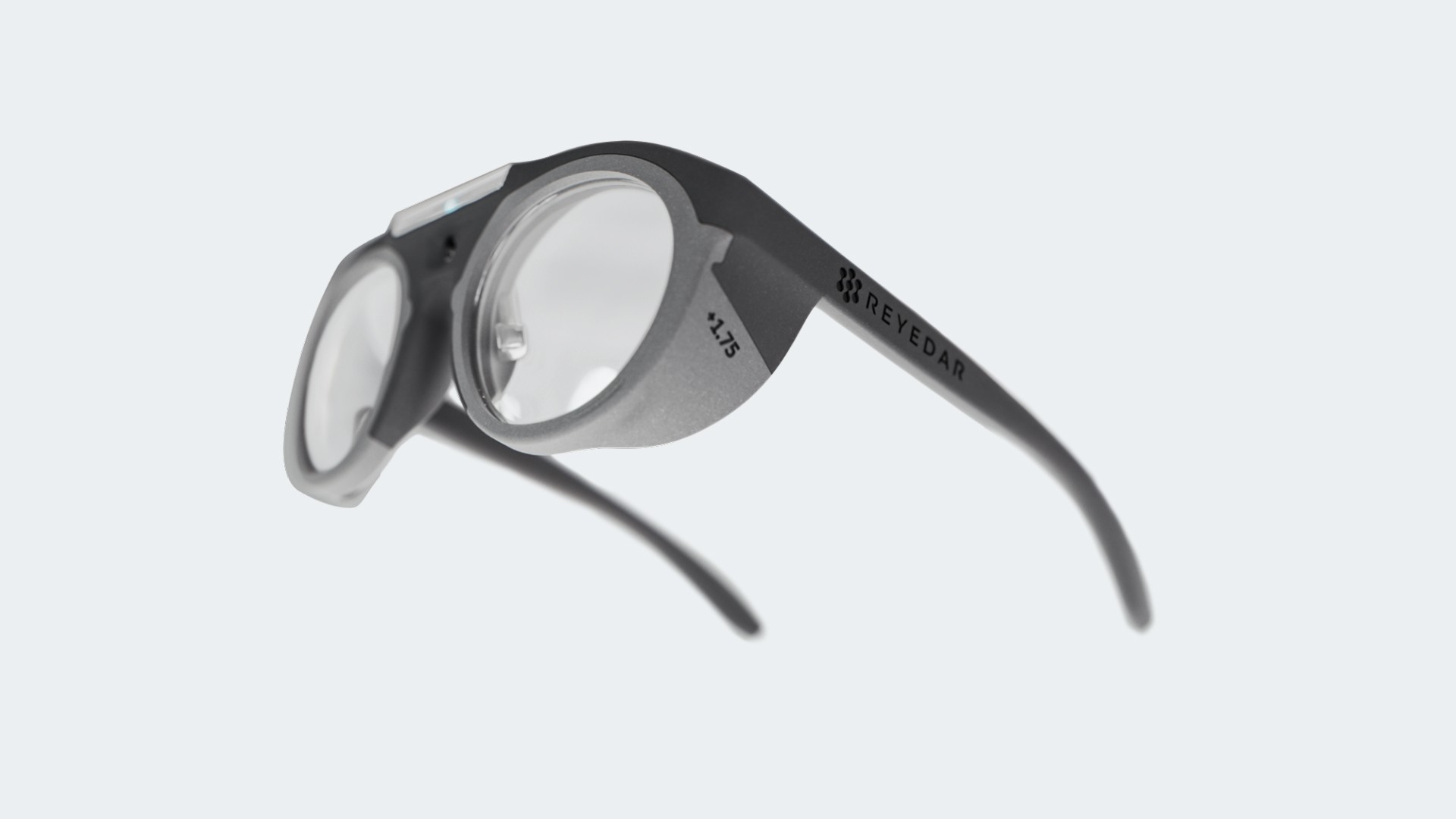
Reyedar, an ophthalmic technology company, built a custom frame with exchangeable prescription lenses to integrate Neon into a glaucoma screening tool, taking advantage of Neon’s calibration-free measurement to make functional testing faster to administer.⁴

OpenBCI integrated the Neon module into Galea, a wireless brain, body, and eye tracking headset, combining Neon’s gaze measurement with EEG, EOG, EMG, EDA, and PPG sensing in a single wearable system.⁵

Image from from Park, G., Han, M. and Oakley, I. (2026), OpenEye: Cross-Device Eye Tracking for Head-Mounted Displays, CC BY 4.0. Original publication.
Pupil Labs builds and sells a dedicated Neon mount for Meta Quest 3. Researchers behind OpenEye developed device-specific mounts for Apple Vision Pro and XREAL Air 2 Ultra, showing how Neon can be used across XR headsets with very different designs.⁶
Each project carried the same module and measurement system into a use case not covered by the standard frame range. The underlying eye tracking pipeline did not change.
Where to go next
Changing the frame determines where and how an eye tracker can be worn. The next question is how to choose the right frame. Check our frame guide for ideas.
This article is part of a series exploring what makes a good eye tracker. Related topics include:
¹ Baumann & Dierkes, Neon Accuracy Test Report, Pupil Labs, 2026. https://doi.org/10.5281/zenodo.18504792
² Neon Geometry: Reference CAD Files for Neon Integrations, Pupil Labs. https://github.com/pupil-labs/neon-geometry
³ A Step Forward in Infant Eye Tracking: Capturing Real-World Gaze Data for Young Children, Pupil Labs Research Digest, 2025. https://pupil-labs.com/blog/a-step-forward-in-infant-eye-tracking
⁴ How Can Eye Tracking Revolutionize Glaucoma Detection?, Pupil Labs, 2023. https://pupil-labs.com/blog/reyedar-ophthalmic-testing
⁵ OpenBCI and Pupil Labs Announce Launch of Wireless, All-in-One Brain, Body, and Eye Tracking Headset, Pupil Labs, 2025. https://pupil-labs.com/blog/openbci-and-pupil-labs-announce-launch-of-wireless-all-in-one-brain-body-and-eye-tracking-headset
⁶ Park, G., Han, M. and Oakley, I., OpenEye: Cross-Device Eye Tracking for Head-Mounted Displays, 2026. https://doi.org/10.1145/3806031
See the full range of Neon frames.
Talk to us about your research setup.